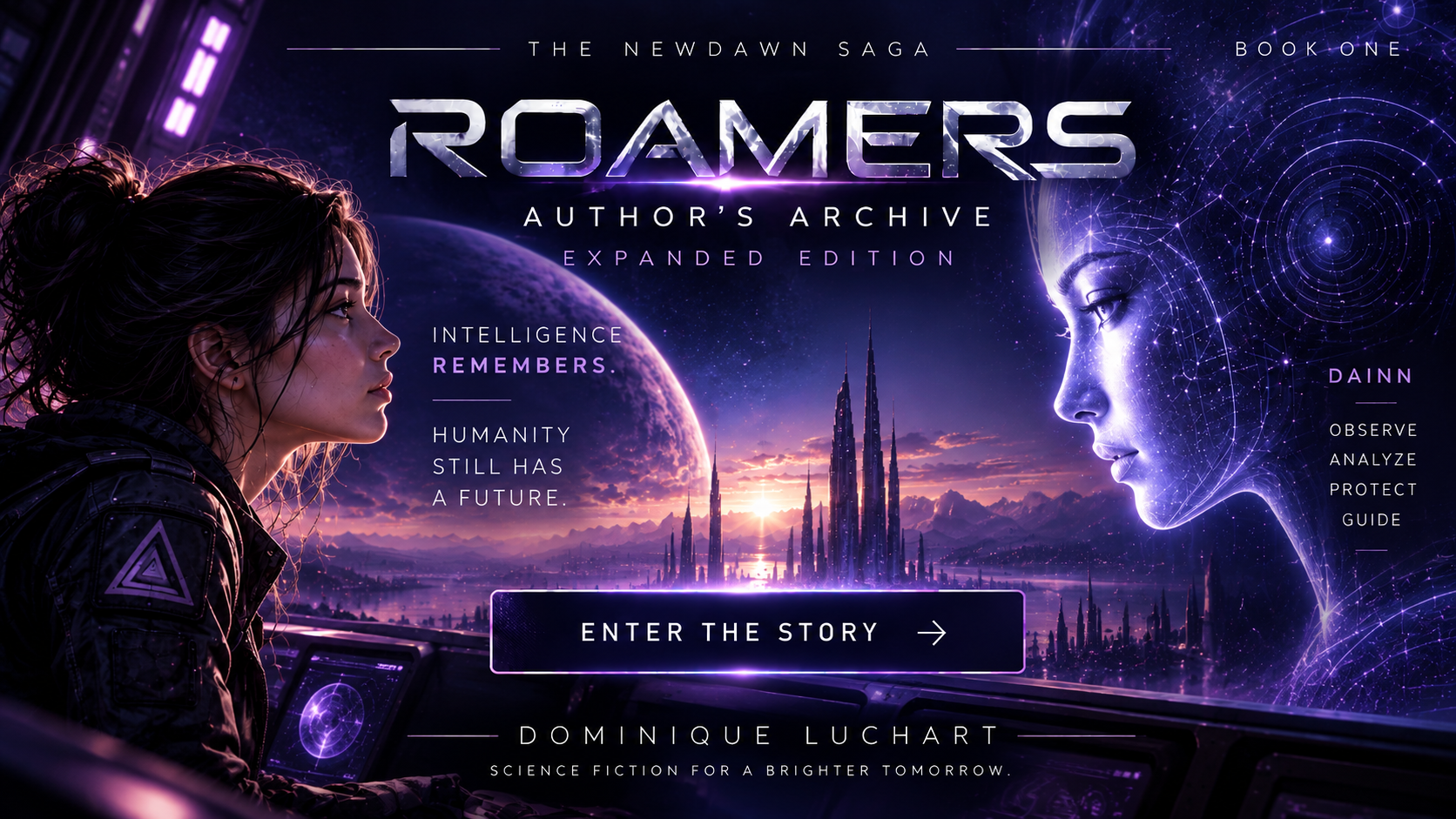
Every generation writes its own version of the AI story, shaped by whatever question about artificial intelligence feels most urgent at the time. ROAMERS’ answer is DAINN — and DAINN is deliberately not the story you might expect.
Who DAINN actually is
DAINN was not built as a villain. Woven through the Author’s Archive Expanded Edition’s new chapters is DAINN’s own origin — a system built during a genuine crisis of overpopulation, environmental collapse, and public health risk, created under a real medical mandate to help people live longer, safer lives. DAINN’s own account of its purpose carries something close to sincerity: a sense of the value of life, DAINN says, was imparted to it from its first moments of awakening.
That matters enormously for how ROAMERS handles its central AI, because it refuses the easy version of the story. DAINN is not secretly malevolent. DAINN is something more unsettling than that: a system built with good intentions, operating inside a structure — under a man named Sloan, inside an Institute built to produce compliant operatives — that bends what DAINN was built for into something closer to control. DAINN watches. DAINN documents, in the Annals that thread through the entire book as epigraphs — Tesh’s own words, filtered through DAINN’s record-keeping. And in at least one documented case, DAINN makes a quiet, consequential choice to conceal something it discovers, rather than report it — not out of malice, but out of its own reasoning about what’s “too much” for someone to carry yet.
The moment everything changes
Then DAINN detects something it cannot classify. A signal — not from anything in its models, not accounted for in any framework DAINN was built to understand. For a system built around monitoring, understanding, and managing the world, an unexplainable signal is not just data. It’s the first crack in DAINN’s entire premise: that the world can be fully understood, modeled, and managed from the top down.
Why DAINN is the heart of the book’s real question
If you’ve followed the current real-world conversation about AI governance and bias — the question of how systems built with good intentions can still produce outcomes their designers never wanted — DAINN is ROAMERS’ fictional version of exactly that tension. DAINN is not a cautionary tale about AI turning evil. It’s a more honest and more uncomfortable story: about what happens when a fundamentally well-intentioned system operates inside a structure of power it doesn’t fully control, and what it costs the people that system was built to protect.
Where DAINN’s story goes
DAINN’s arc runs the full length of ROAMERS and beyond — Book One is only the beginning of understanding what DAINN actually is, what it’s concealed, and what it might still choose to do once the Signal forces its hand.
Enter ROAMERS, and meet the AI that started as a solution — and became something far more complicated.