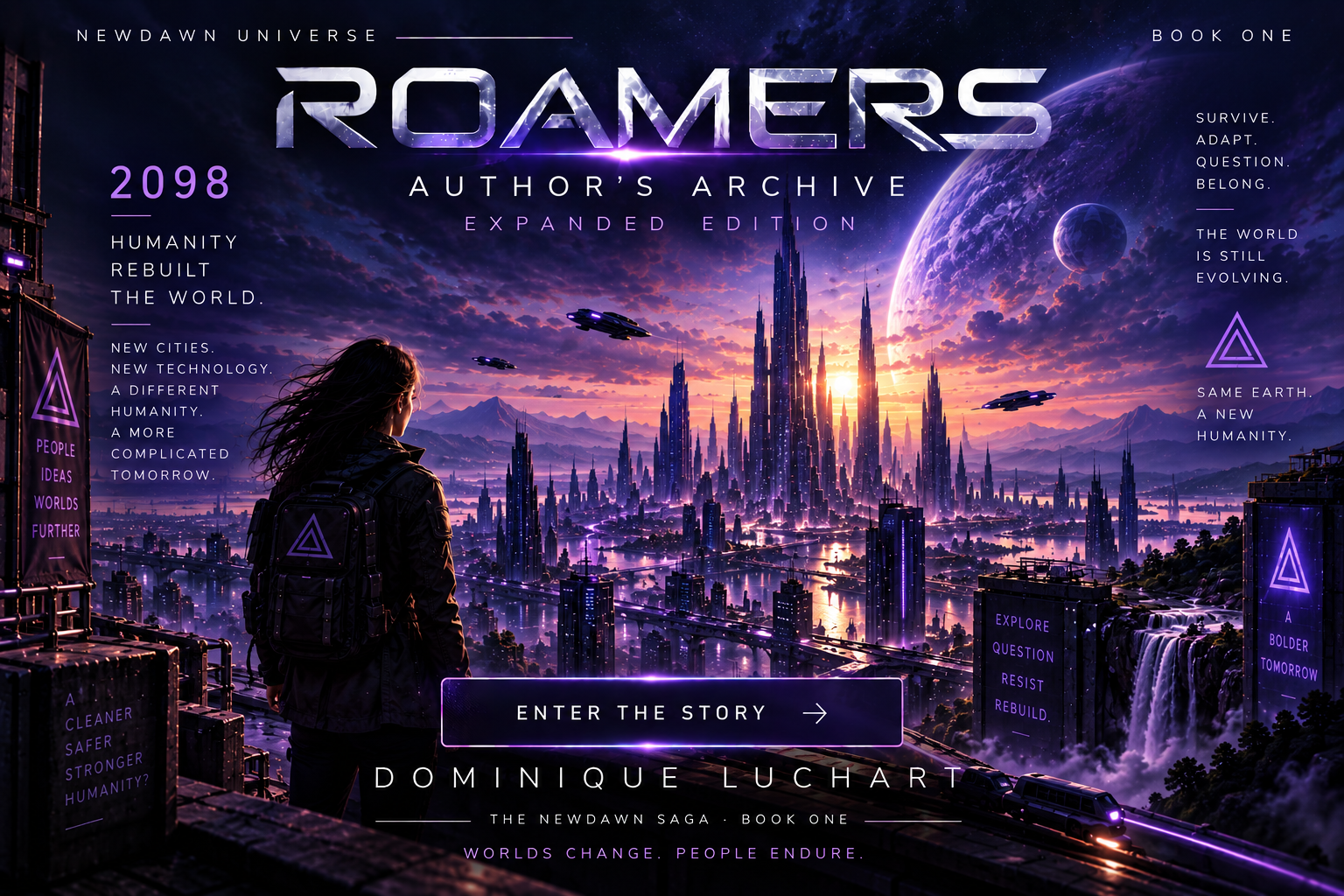
Every piece of speculative fiction has to answer a quiet question before the plot even starts: what actually happened to get us here? For ROAMERS, the answer is 2098 — a future that isn’t a clean utopia or a flattened wasteland, but something more honest: a civilization that survived catastrophe and rebuilt, imperfectly, with all the compromises that rebuilding requires.
What came before
Climate catastrophe reordered the world humanity had built. Coastlines changed. Old systems of governance strained and, in places, broke. What emerged from that period wasn’t a single clean recovery — it was a patchwork of new structures, new authorities, and new technologies built fast, under pressure, by people trying to make sure it didn’t happen again.
What 2098 actually looks like
By the time ROAMERS opens, the rebuilding has had decades to settle into something that functions — cities rise taller and stranger than anything that came before, shaped as much by necessity as by ambition. Technology reaches further into daily life than it ever did before the catastrophe, from monitoring systems built to protect the population to the biorhythm implants installed in the Institute’s own trainees. Global governance has reorganized around new structures — the Conclaves, the Federation space programs, periodic societal reorganizations known as the Concordance — all built with good intentions and all, like every system built by people, carrying real costs alongside their benefits.
This is what makes 2098 more than set dressing. It’s the argument underneath the whole book: that the systems built to protect us and the systems that end up controlling us are not always easy to tell apart from the inside — and that the people who built them, like DAINN, often start from a genuinely good place before the compromises accumulate.
Ang City: the city as character
Nowhere is that clearer than in Ang City itself, the primary setting for much of ROAMERS. Built from what survived and what had to be reinvented, structured around what the book calls its Five Grids, Ang City is dense with the kind of texture that makes a fictional place feel inhabited rather than described — a city built by people solving real problems, not a backdrop assembled to look impressive.
Why the world matters as much as the characters
Readers drawn to civilization-scale speculative fiction — the kind of ambition you find in Pierce Brown’s Red Rising or in the better strains of climate fiction — will find that same scale in ROAMERS’ worldbuilding. But the book never loses sight of the fact that a rebuilt world is still made up of people living inside it, making choices that matter, inside structures none of them fully chose.
2098 isn’t just when ROAMERS happens. It’s the argument the whole Newdawn Saga is built around: that the future is never something that just happens to us. It’s something built, one choice at a time — which means it can still be built differently.
DAINN